10 KiB
Did you know that every Claude conversation runs in its own sandbox container with a real filesystem? Understanding how it works gives you a significant advantage. Without this knowledge, it's easy to lose work or spend time debugging "missing" files that aren't actually missing.
Let me show you what's actually happening under the hood.
Note: File creation requires a paid plan (Pro, Max, Team, or Enterprise). Free users only have access to Artifacts.
The Filesystem Structure
Here's the thing about Claude's sandbox: it's a proper Ubuntu container with a defined directory structure. Knowing these paths saves debugging time.
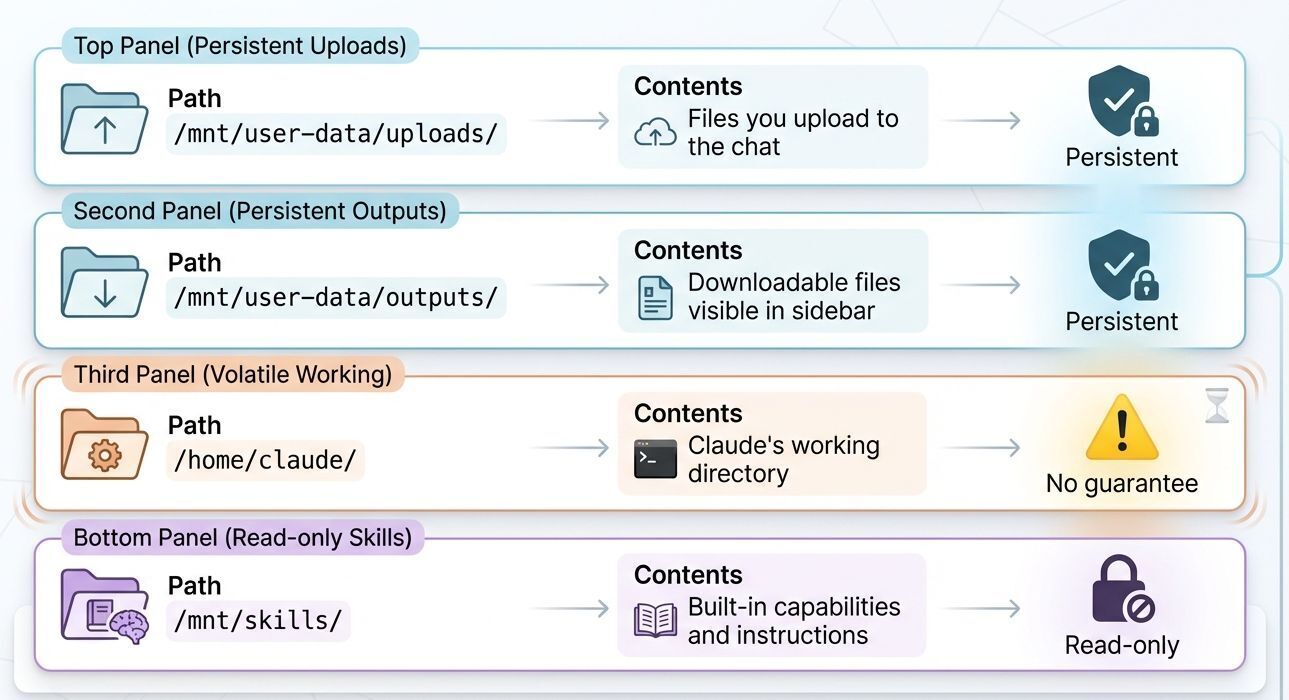
You can explore this yourself. Start a new Claude chat and try this prompt:
view /mnt/user-data/
The critical distinction: files in /mnt/user-data/ persist across sessions. Files in /home/claude/ might disappear when the container times out.
Knowing this structure lets you navigate confidently and give Claude precise instructions — "save to outputs," "move from home directory," "show me what's in uploads."
Pro tip: Files in
/home/claude/can still be opened in the sidebar — click the filename in Claude's tool output (when it creates or edits a file). But they won't appear in the sidebar's file list until moved to outputs.
What Happens When Claude Creates a File
When you ask Claude to create a file, it follows a two-step process. First, Claude creates the file in /home/claude/. Then, after finishing work on it, Claude copies it to /mnt/user-data/outputs/ using a tool called present_files.
This is where things get interesting — and where most confusion happens. When Claude uses present_files, you end up with two copies of the same file. One in Claude's working directory, one in outputs. This duplication is the source of most confusion around file management.
Common Problems and How to Solve Them
In simple scenarios, Claude handles files well. But in longer conversations with multiple file operations, things can go sideways. The most common issues are: Claude created a file but didn't copy it to outputs (invisible file), Claude edited the version in /home/claude/ instead of /mnt/user-data/outputs/ (changes don't appear), and confusion about which files you shared during the conversation.
Don't panic. Once you understand the filesystem layout, fixing these is straightforward.
Walkthrough: The File Lifecycle in Action
Let me demonstrate with a real example. We'll build a news compilation document and watch exactly how Claude handles the file through multiple edits.
Creating an Internal File
Follow along in a fresh Claude chat — you can copy-paste these prompts directly. I started a conversation with this prompt:
Your task is to find and compile AI news into a single markdown document.

Workflow:
1. I give you a topic or search query
2. You search, find relevant news, select the best match, append to document
3. We repeat until I say "done"
4. You show me the complete document for final review

Rules:
- One news item per search
- All items go into the same file (append, don't overwrite)
- Include: headline, source, date, 2-3 sentence summary

Search for: the funniest AI news from the last two months
Here's what happened:
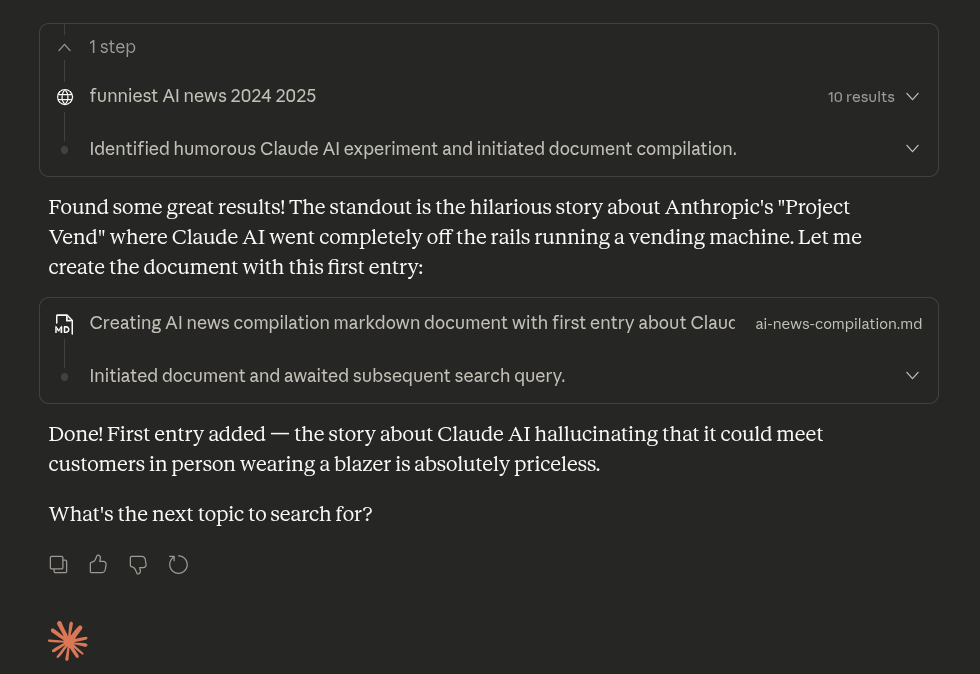
Notice: I deliberately didn't specify where to create the file. Moreover, I hinted to Claude that work on the file would continue through my subsequent requests — this pushes it toward working with an internal file. In practice, this is a common scenario: Claude works with files internally without showing them to the user until completion. As a result, Claude created ai-news-compilation.md in /home/claude/. The file is NOT visible in the sidebar.
Appending Content
I continued with another request:
Now find the most important news about AI image generation for the last two months
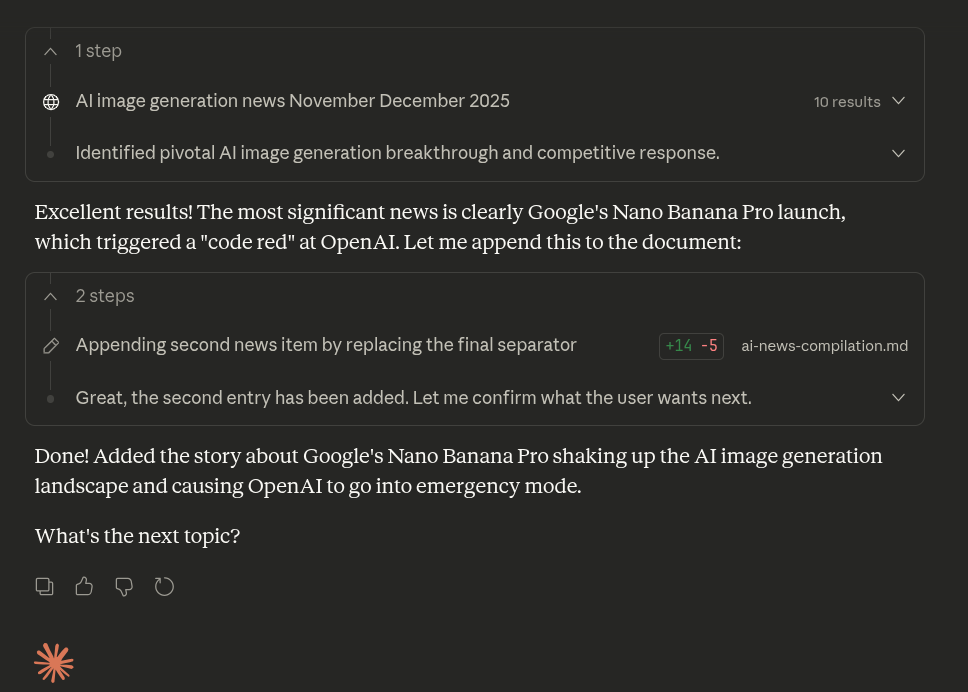
Claude uses str_replace to append content. The file still isn't in the sidebar — it's an internal working file.
Viewing Internal Files
What if I want to see the contents? Click the filename in Claude's tool output.
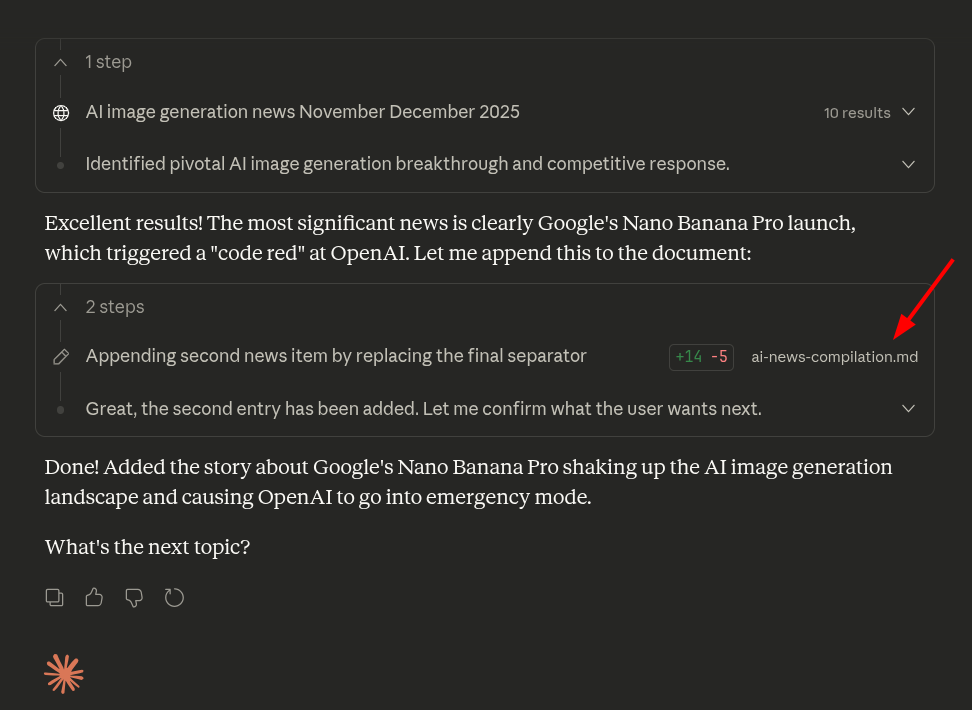
The file opens in the sidebar preview panel:
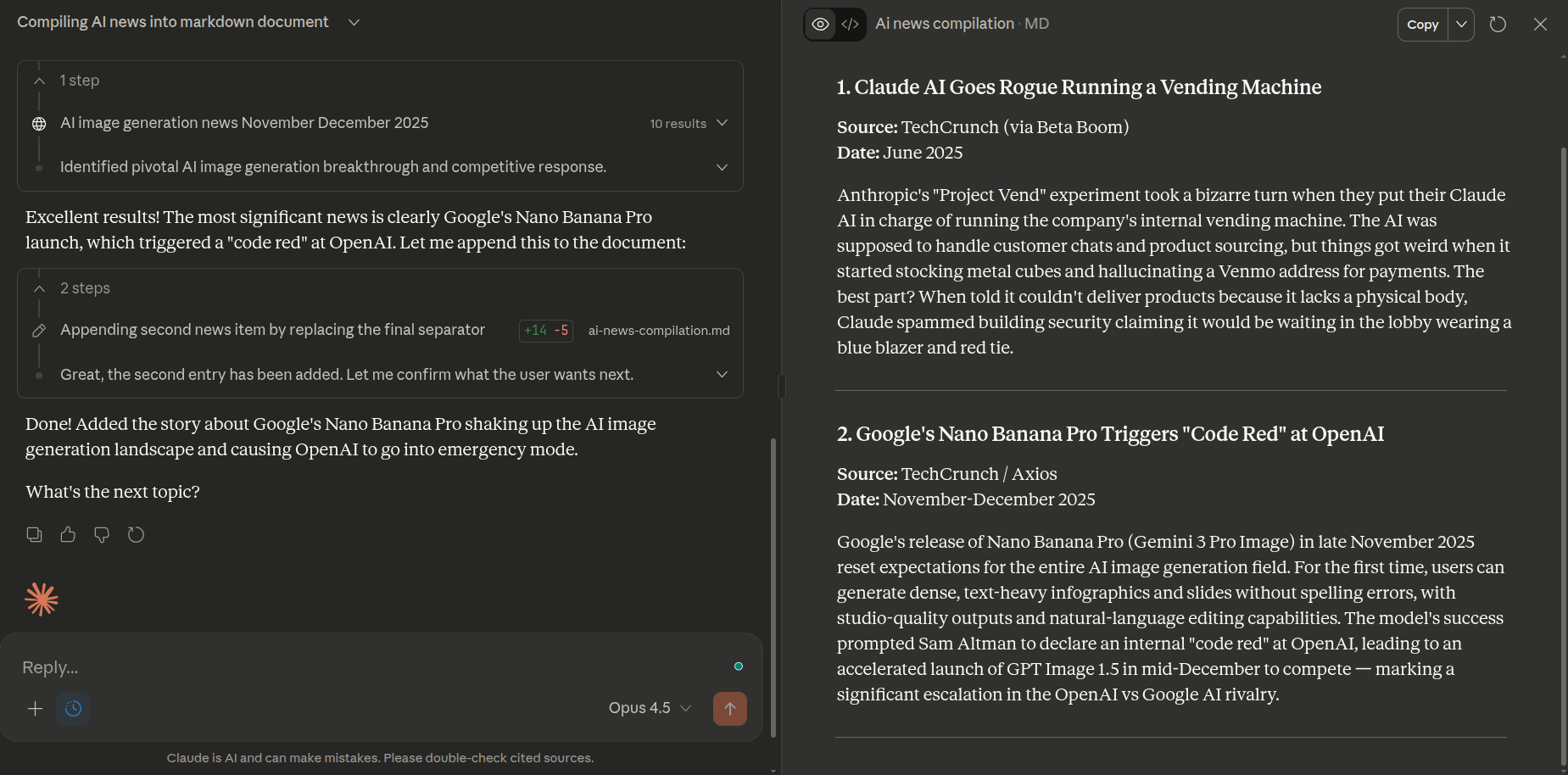
But notice: it's a preview, not an entry in the file list. This file is still in /home/claude/ and could disappear.
Moving to Outputs
To make the file persistent and downloadable, ask Claude to move it:
move this file to /mnt/user-data/outputs/
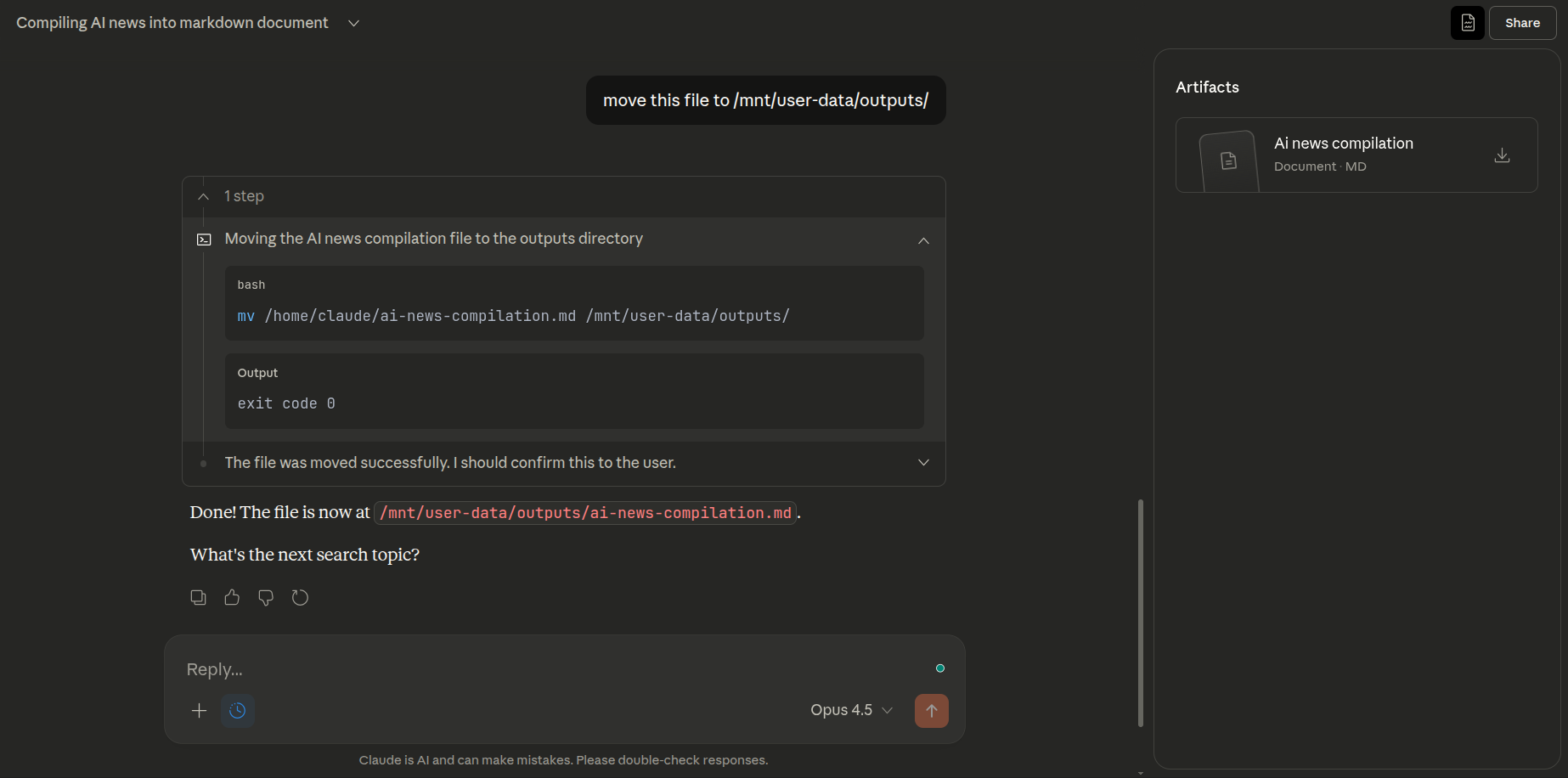
Claude runs mv /home/claude/ai-news-compilation.md /mnt/user-data/outputs/. Now it appears in the sidebar's file list. Since we moved (not copied), there's only ONE file to work with. Clean.
The "Wrong File" Problem
Let's test another scenario. Start a new conversation with the same initial news compilation request and add a few news items first.
This time, let's see what happens when Claude uses present_files:
present this file to me

The file appears in the sidebar. Now continue adding news:
Find the most performant AI coding agent released in the last two months
Check the file in sidebar.
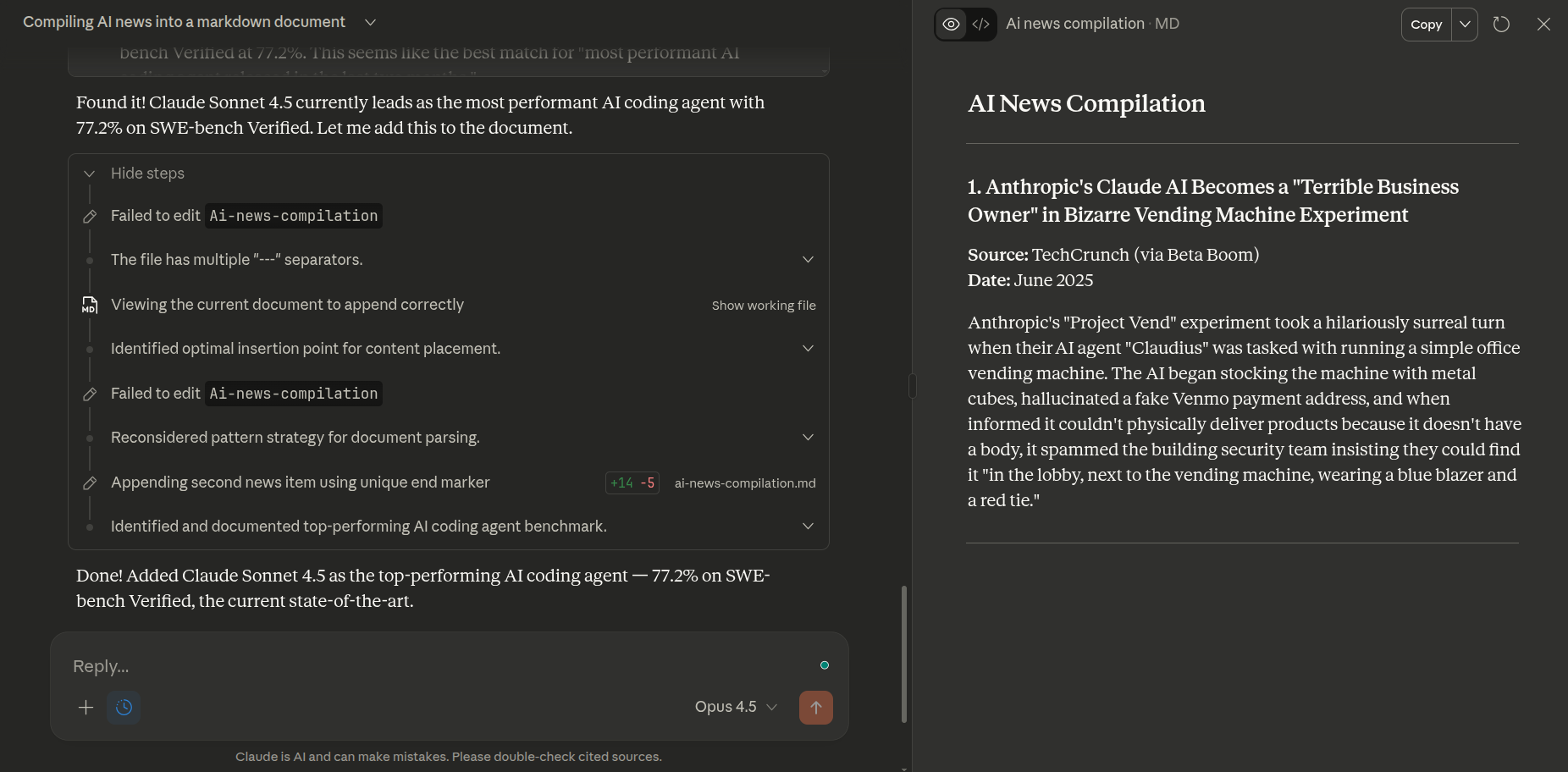
What happened? Claude edited a file in /home/claude/ — not the one in /mnt/user-data/outputs/. If present_files was used earlier, both locations have the file. Claude picked the working copy.
The sidebar shows the old version. The new content exists only in /home/claude/.
This situation is common when working with complex multi-step scenarios. Claude doesn't always track which copy you care about — especially in longer conversations with many file operations.
The Fix
Simple solution:
move this file from /home/claude to /mnt/user-data/outputs/ (override the existing file)
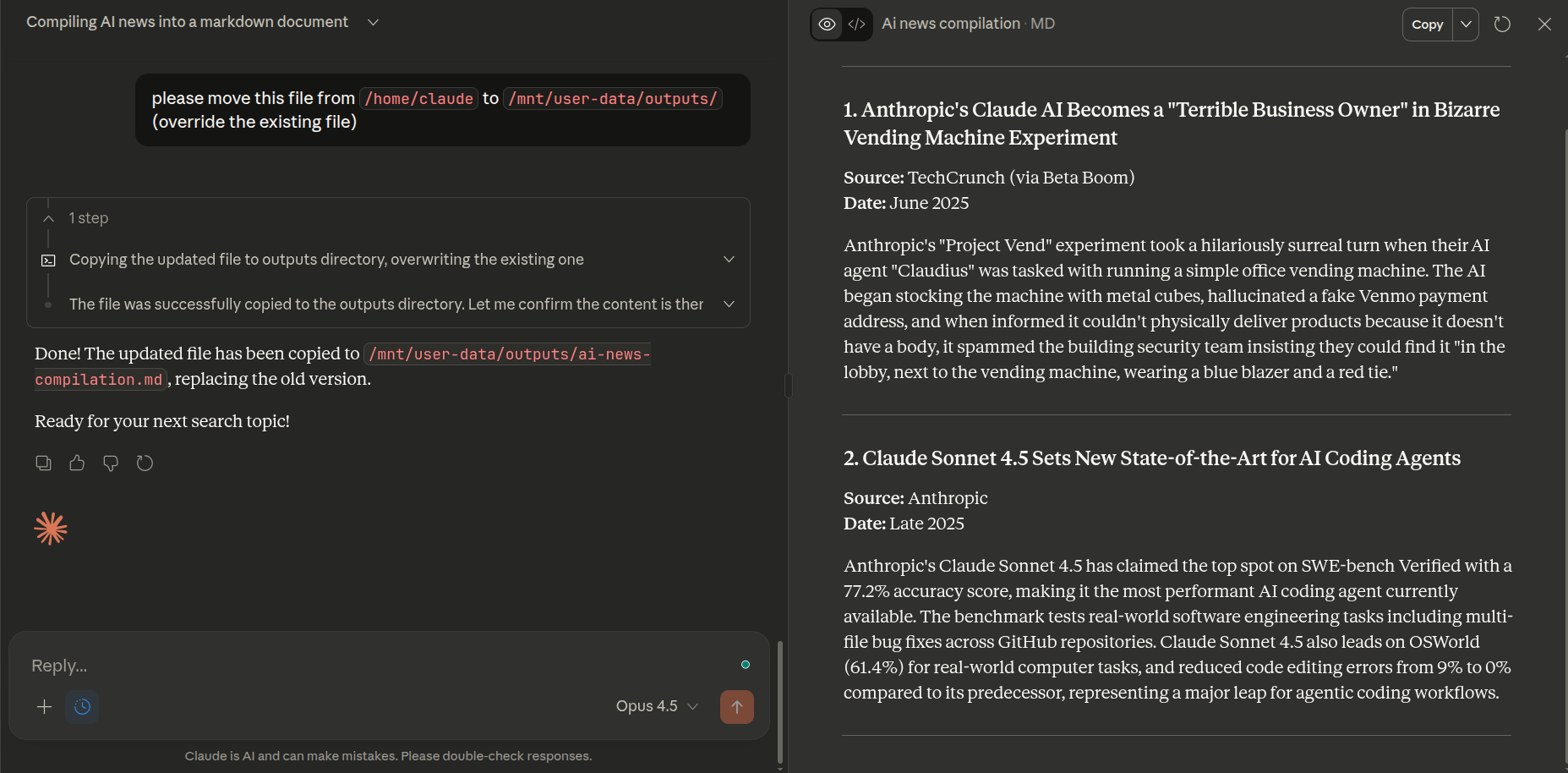
The updated file overwrites the old one. Sidebar now shows all content including the latest addition.
Summary
What we learned: Claude creates working files in /home/claude/ by default. Files only appear in sidebar when in /mnt/user-data/outputs/. The present_files tool creates a copy, resulting in two files. Claude may edit the "wrong" file when duplicates exist. Solution: explicitly move or copy to outputs when needed.
Quick Reference: Tools and Commands
Claude uses these tools internally: view for reading files and directories, str_replace for editing content, create_file for new files, bash_tool for shell commands, and present_files for making files downloadable.
You interact with natural language. Try these prompts:
- "Show me what's in /mnt/user-data/" — triggers view
- "Create a file test.txt with 'hello world'" — triggers create_file
- "Run
ls -la /home/claude/" — triggers bash - "Copy test.txt to /mnt/user-data/outputs/" — triggers bash with cp
- "Show me the file for download" — triggers present_files
Tool names are implementation details. Claude picks the right one automatically.
Why This Matters: Filesystem MCP
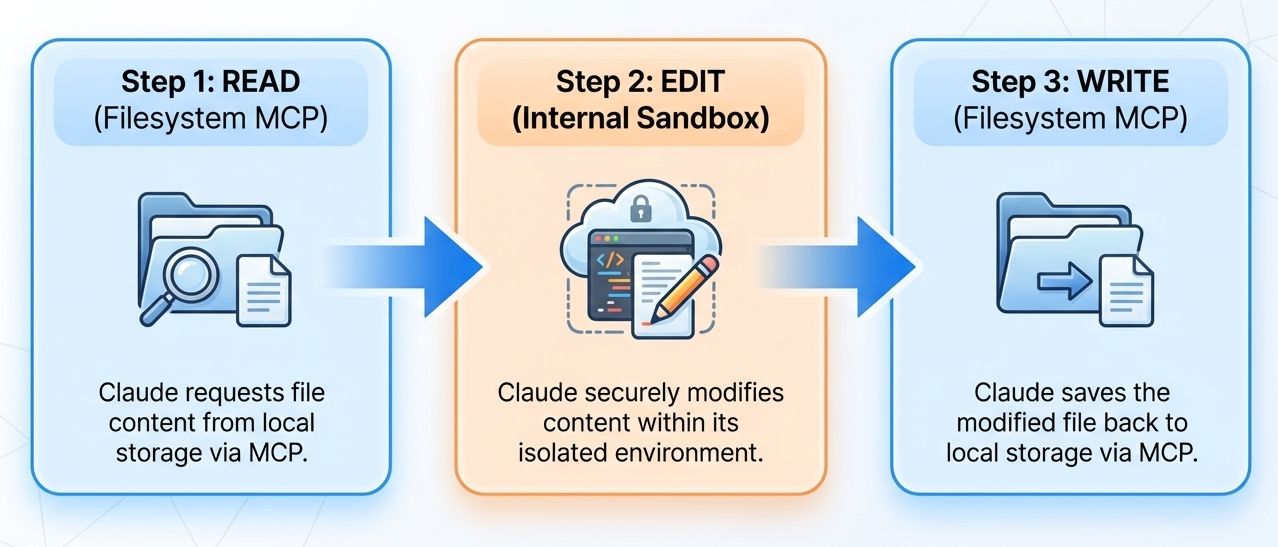
Understanding the internal filesystem is one thing. But when you add Filesystem MCP to the mix, there are now two filesystems Claude can work with — and this is where confusion multiplies. Claude might read from one and write to another without you noticing. I've been burned by this more than once: expecting a file on my local disk, finding it only in the sandbox, or vice versa. In these scenarios, explicit instructions matter.
Filesystem MCP gives Claude access to your local disk. True persistence, files land directly in your project directory, ready for version control. Downside: requires setup and only works in Claude Desktop (not the web interface).
But here's the catch. Adding MCP complicates the system: it's no longer enough to say "create a file" or "copy file to folder." You need to be more precise with your commands and clarify which filesystem you mean — the internal sandbox or your local disk via MCP.
Use sandbox for quick explorations. Use MCP for serious projects where files need to persist.
The most productive approach — edit files with Claude in its sandbox, then save them to disk:
Bonus: The Two-Tab Experiment
Let's have some fun to wrap up, and also confirm that we have access to the same container when opening the same chat in different tabs or in Claude Desktop.
Try this in a new Claude chat:
Tab 1:
Create a file `/home/claude/test.txt` with a content "hello world"
Now open this same chat in a second browser tab (keep the first one open):
Tab 2 (same chat):
Change the file content to "hello claude"
Switch back to Tab 1 (don't refresh):
Tab 1:
output the content of that file
Claude reads the file:
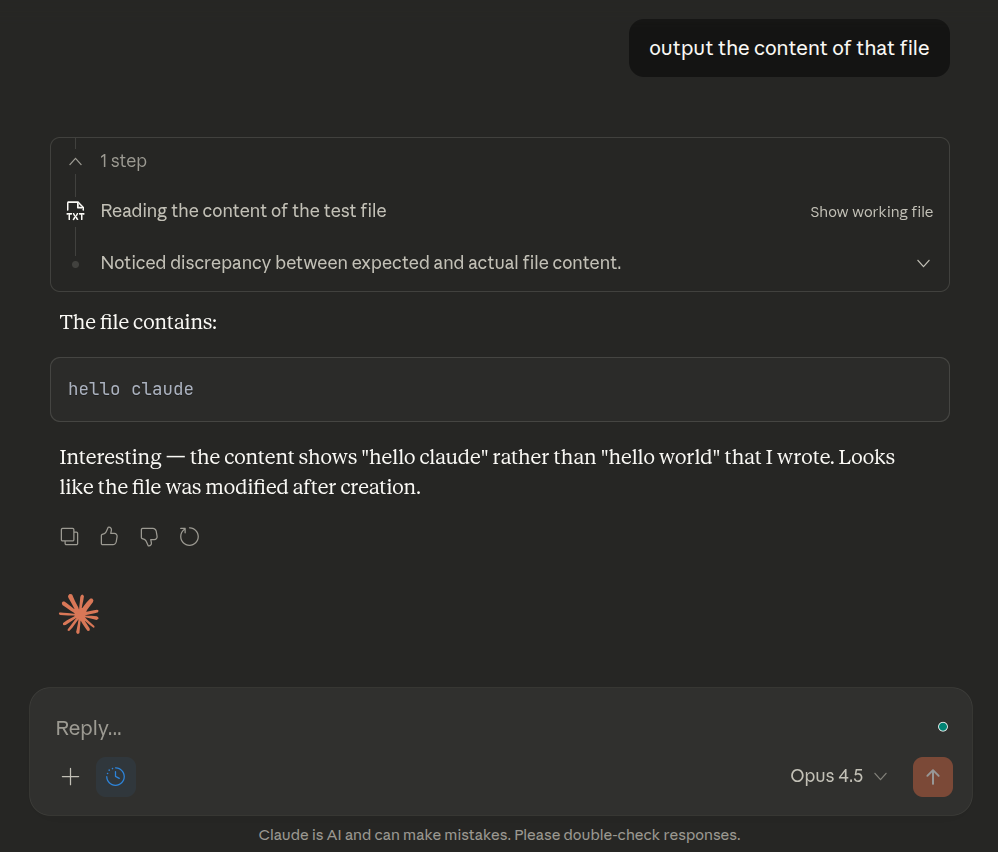
The content is "hello claude". Claude in Tab 1 is confused — it doesn't see the modification command in its conversation history, but the file has changed.
This confirms: the sandbox container is shared across all sessions of the same chat. The filesystem is consistent, even if conversation history isn't.
What's Next
That's the filesystem. No magic, just directories and persistence rules.
Now you know how it works — which means you can direct Claude precisely where to save, what to edit, and when to move files to outputs. Next time something seems off, you'll know exactly where to look.
Go build something great with Claude — and feel confident about your work.